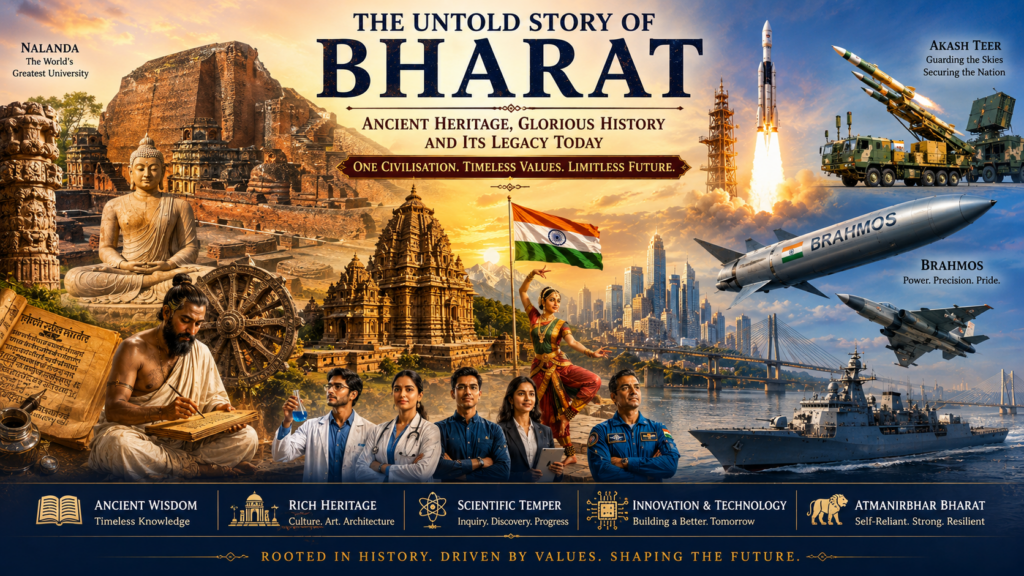
Bharat is more than a name associated with a geographical region. It represents a civilisational journey stretching across thousands of years, shaped by knowledge, culture, philosophy, art, science, traditions and countless generations.
From ancient settlements and magnificent temples to universities, kingdoms, literature and scientific achievements, the story of Bharat is vast and fascinating.
Much of this heritage continues to influence Indian society and the wider world even today.
The Ancient Roots of Bharat
The history of Bharat reaches deep into antiquity.
The Indus Valley Civilisation demonstrated remarkable achievements in urban planning, architecture, sanitation, craftsmanship and trade.
Cities such as Harappa, Mohenjo-daro, Dholavira and Lothal reveal evidence of organised communities and sophisticated systems developed thousands of years ago.
These ancient settlements remind us that the Indian subcontinent was home to complex societies long before the rise of many later civilisations.
A Civilisation Built on Knowledge
One of the most remarkable features of ancient Bharat was its emphasis on knowledge.
The Vedas, Upanishads, epics and numerous philosophical traditions contributed to an enormous intellectual heritage.
The Ramayana and Mahabharata became foundational works of Indian cultural tradition and continue to influence literature, art, theatre and popular culture.
Ancient scholars explored subjects ranging from mathematics and astronomy to medicine, linguistics and philosophy.
The Indian knowledge tradition was not confined to one region. Different parts of the subcontinent developed their own languages, literature, customs and intellectual traditions.
Together, they created a remarkably diverse civilisation.
Nalanda, Takshashila and the Tradition of Learning
Ancient Bharat was also home to renowned centres of learning.
Nalanda became one of the most famous institutions of the ancient world, attracting students and scholars from different parts of Asia.
Takshashila was another important centre of education and intellectual exchange.
These institutions represented a tradition in which learning, debate, philosophy and scholarship were highly valued.
The legacy of this educational culture remains relevant today as India seeks to strengthen its position as a global centre for knowledge, science and innovation.
Mathematics and Scientific Contributions
Ancient Indian scholars made important contributions to mathematics and astronomy.
The development and widespread use of the decimal place-value system and the concept of zero became fundamental to modern mathematics.
Indian astronomers studied celestial movements and developed sophisticated mathematical methods.
Scholars such as Aryabhata made significant contributions to astronomy and mathematics.
Centuries later, these intellectual traditions would become part of the global history of scientific development.
Ayurveda and Yoga
India’s contribution to health and well-being is another important part of its civilisational legacy.
Ayurveda developed a comprehensive approach to health involving diet, lifestyle, medicinal plants and traditional practices.
Yoga, with its origins in ancient Indian traditions, has now become a global phenomenon.
Millions of people across the world practise yoga for physical fitness, mental discipline and overall well-being.
These traditions demonstrate how knowledge originating in ancient Bharat continues to find relevance in the modern world.
Temples, Forts and Architectural Heritage
Across India, thousands of temples, forts, palaces and monuments preserve the artistic achievements of earlier generations.
From the magnificent temples of South India to the rock-cut caves of western India, from the forts of Maharashtra and Rajasthan to the architectural traditions of Odisha, Karnataka and Tamil Nadu, India’s built heritage reflects extraordinary diversity.
These structures were not merely places of worship or royal residences.
They were often centres of art, music, education, social activity and craftsmanship.
Their architecture provides valuable insight into the societies that created them.
A Land of Many Kingdoms
The history of Bharat includes numerous kingdoms and empires.
The Mauryas, Guptas, Cholas, Pallavas, Rashtrakutas, Chalukyas, Vijayanagara rulers, Marathas and many other dynasties shaped different parts of the subcontinent.
Each period contributed to India’s political, cultural and architectural heritage.
The Gupta period is often associated with major achievements in science, mathematics, literature and art.
The Cholas developed a powerful maritime presence and created magnificent temple architecture.
The Vijayanagara Empire produced extraordinary urban and architectural achievements.
The Marathas developed a formidable political and military power and left behind a remarkable network of forts.
Together, these chapters form a vast and diverse historical landscape.
Bharat’s Cultural Continuity
Despite political changes and historical upheavals, many elements of Indian civilisation have survived through generations.
Languages, festivals, traditions, classical music, dance, cuisine, religious practices, crafts and family customs continue to connect modern Indians with their heritage.
This continuity is one of the defining characteristics of Indian civilisation.
Traditions have not simply remained frozen in the past. They have adapted to changing circumstances while retaining their core identity.
The Struggle for Freedom
The arrival and expansion of European colonial powers eventually transformed India’s political and economic landscape.
British colonial rule had a profound impact on Indian society and economy.
The struggle for independence became one of the defining chapters of modern Indian history.
Millions of Indians participated in different forms of resistance and political movements.
The independence movement eventually led to freedom on 15 August 1947.
The birth of independent India marked a new chapter in the long story of Bharat.
Bharat in the Modern Era
Independent India inherited a vast and complex country with enormous challenges.
Yet the nation gradually built institutions, expanded education, developed industries and invested in science and technology.
Today, India is a major economy with growing capabilities in information technology, space exploration, pharmaceuticals, manufacturing, digital technology and infrastructure.
India’s transformation demonstrates that a civilisation can preserve its historical identity while embracing modern development.
The Legacy of Bharat Today
The legacy of Bharat can be seen everywhere in modern India.
It can be found in the practice of yoga, the continuing popularity of Ayurveda, the preservation of classical arts, the celebration of ancient festivals and the protection of historical monuments.
It can also be seen in modern scientific institutions, universities, technology companies and India’s growing contribution to global innovation.
The past and present are not separate worlds.
They are connected through generations of knowledge and cultural continuity.
Why Bharat’s Heritage Matters
Understanding Bharat’s history is not simply about looking backward.
History can provide a deeper understanding of identity, culture and the foundations on which modern India has developed.
At the same time, appreciating heritage does not mean ignoring the challenges of the present.
India’s future will depend on its ability to preserve its cultural and historical treasures while continuing to advance in science, technology, education, economic development and social progress.
Carrying the Legacy Forward
The story of Bharat is still being written.
The ancient civilisation that produced remarkable achievements in knowledge, art, architecture and philosophy has entered a new era of technology, innovation and global engagement.
The responsibility of the present generation is not merely to remember the past, but to preserve it, learn from it and carry its finest values into the future.
Bharat’s heritage belongs not only to history books and museums.
It lives in India’s languages, traditions, monuments, knowledge systems, festivals, arts and the everyday lives of its people.
The untold story of Bharat is therefore not a story that ended centuries ago.
It is a continuing journey—one that connects an ancient civilisation with a modern nation and carries the legacy of the past into the possibilities of tomorrow.
Satyam Shivam Sundaram
सत्यं शिवं सुन्दरम्
सत्यं वद । धर्मं चर । राष्ट्राय समर्पित भव ।
Truth. Righteousness. Dedication to the Nation.