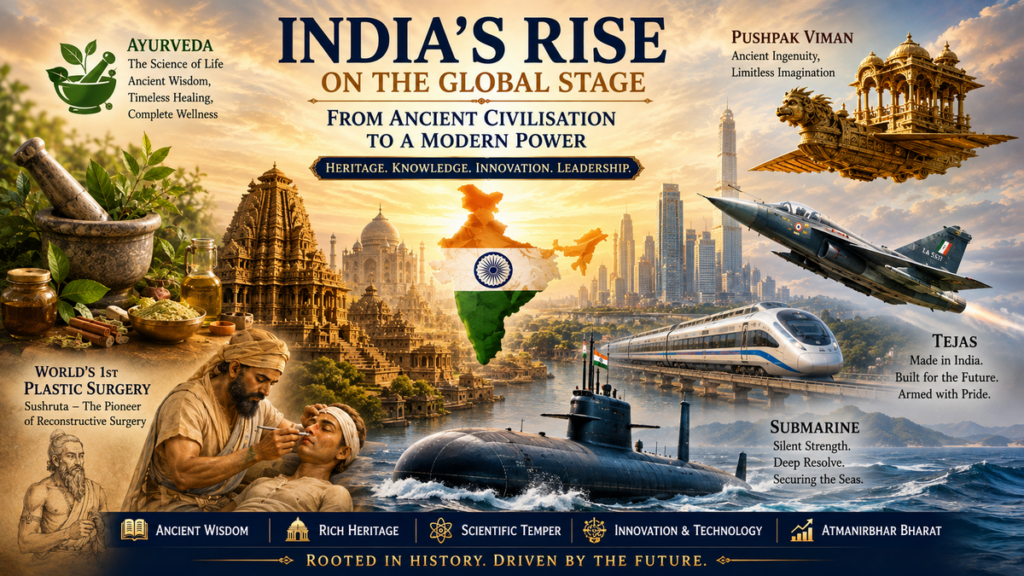
India’s journey from one of the world’s oldest civilisations to a modern global power is a remarkable story of resilience, knowledge, culture and transformation. From the ancient cities of the Indus Valley Civilisation to today’s rapidly developing economy, India has continuously evolved while preserving a deep connection with its civilisational roots.
Today, India is emerging as an important voice in global affairs, driven by economic growth, technological advancement, infrastructure development, a young population and an increasingly influential role in international relations.
The Foundations of an Ancient Civilisation
India’s civilisational history stretches back thousands of years. The Indus Valley Civilisation, with important centres such as Harappa and Dholavira, demonstrated advanced urban planning, sophisticated drainage systems, trade networks and skilled craftsmanship.
Ancient India also became a centre of learning and intellectual achievement. Universities such as Takshashila and Nalanda attracted students and scholars from different parts of Asia.
Indian mathematicians and astronomers made significant contributions to human knowledge. The concept of zero, the decimal system and important developments in mathematics and astronomy became part of a knowledge tradition that influenced the wider world.
India’s philosophical traditions, literature, medicine, architecture and spiritual thought also travelled far beyond the subcontinent.
A Land of Knowledge, Culture and Innovation
India’s ancient heritage was not limited to monuments and historical records. It included systems of knowledge that continue to influence the modern world.
Ayurveda developed an extensive approach to health and well-being. Yoga, which originated in India, has now become a global practice followed by millions of people.
Indian literature and languages produced an extraordinary body of knowledge. Sanskrit works, Tamil literature and numerous regional traditions contributed to a rich cultural landscape.
India’s temples, forts, palaces, sculptures and monuments continue to reflect the artistic and engineering capabilities of earlier generations.
This heritage remains an important part of India’s identity even as the country moves rapidly into the future.
From Colonial Rule to Independence
India’s modern transformation cannot be understood without remembering the long period of colonial rule.
The struggle for independence brought together people from different regions, languages and communities. Leaders, revolutionaries, social reformers and ordinary citizens contributed to the movement for freedom.
On 15 August 1947, India became an independent nation.
The country then faced enormous challenges. Poverty, illiteracy, inadequate infrastructure and economic limitations were among the major issues confronting the newly independent nation.
Yet India chose the path of democracy and institution-building.
The Constitution established a framework based on democratic governance, fundamental rights and the rule of law.
Building a Modern India
Over the decades after independence, India steadily developed its industrial, agricultural, scientific and technological capabilities.
The Green Revolution helped transform agricultural production. Public institutions and research organisations expanded the country’s scientific capabilities.
India’s space programme became another example of long-term national investment in science and technology. From launching satellites to exploring the Moon and studying the Sun, India’s space achievements have attracted international attention.
The growth of India’s information technology sector also transformed the country’s economic position and created a major global presence in software and digital services.
India’s Digital Transformation
One of the most significant changes in modern India has been the rapid expansion of digital technology.
Digital payments, online banking, mobile connectivity and digital public services have changed the way millions of Indians interact with businesses and government institutions.
India has developed a large digital ecosystem that is increasingly attracting international attention.
The growth of startups and technology companies has also created new opportunities for innovation, entrepreneurship and employment.
Artificial intelligence, semiconductor manufacturing, advanced telecommunications and other emerging technologies are becoming increasingly important to India’s future.
Infrastructure and Economic Growth
Modern India is also witnessing major infrastructure development.
New highways, railways, airports, ports, metro systems and urban infrastructure are connecting different parts of the country.
The expansion of manufacturing and initiatives supporting domestic production are strengthening India’s ambitions to become a major global manufacturing centre.
India’s large domestic market, growing middle class, skilled workforce and expanding digital economy provide significant foundations for future economic growth.
India’s Growing Global Influence
India’s rise is not limited to economics.
The country has increasingly become an important participant in international discussions involving trade, climate change, energy security, technology, defence and global development.
India maintains relationships with countries across Asia, Europe, Africa, the Middle East and the Americas.
Its participation in organisations and groupings such as the United Nations, G20, BRICS, Quad and other international forums reflects its expanding diplomatic engagement.
India’s relationships with both developed and developing nations demonstrate its desire to play a constructive role in a changing world order.
A Stronger and More Capable India
India is also strengthening its defence capabilities.
The country has developed significant expertise in missile technology, naval systems, aircraft, satellites and other defence technologies.
At the same time, India is increasingly focusing on domestic defence manufacturing and reducing dependence on imports.
The growing emphasis on indigenous production reflects a broader national objective: building capabilities within India while participating more actively in global supply chains.
The Power of India’s Young Population
India possesses one of the world’s largest young populations.
This demographic strength can become a major advantage if supported by quality education, skills development, employment opportunities and entrepreneurship.
Young Indians are increasingly participating in technology, science, business, sports, creative industries and social innovation.
Their ambitions and capabilities will play an important role in determining India’s position in the decades ahead.
Preserving the Past While Building the Future
Perhaps one of India’s greatest strengths is its ability to combine tradition with modernity.
Ancient temples stand alongside modern cities. Traditional knowledge exists alongside advanced technology. Centuries-old cultural practices coexist with digital innovation.
India’s rise does not require abandoning its heritage.
Instead, its civilisational identity can provide a foundation for confidence while modern institutions, science, technology and economic development shape its future.
The Road Ahead
India’s transformation is still underway.
The country faces challenges including inequality, urbanisation, environmental pressures, employment generation, education and the need for continued economic reforms.
But the opportunities are equally significant.
With a vast population, expanding economy, technological capabilities, rich cultural heritage and growing international influence, India has the potential to become one of the defining powers of the 21st century.
The story of India is therefore not simply a story of economic growth.
It is the story of an ancient civilisation adapting to a rapidly changing world.
From the knowledge traditions of ancient India to today’s digital and technological revolution, the journey continues.
India is carrying its past into the future—and its rise on the global stage is becoming one of the most significant stories of our time.
Satyam Shivam Sundaram
सत्यं शिवं सुन्दरम्
सत्यं वद । धर्मं चर । राष्ट्राय समर्पित भव ।
Truth. Righteousness. Dedication to the Nation.