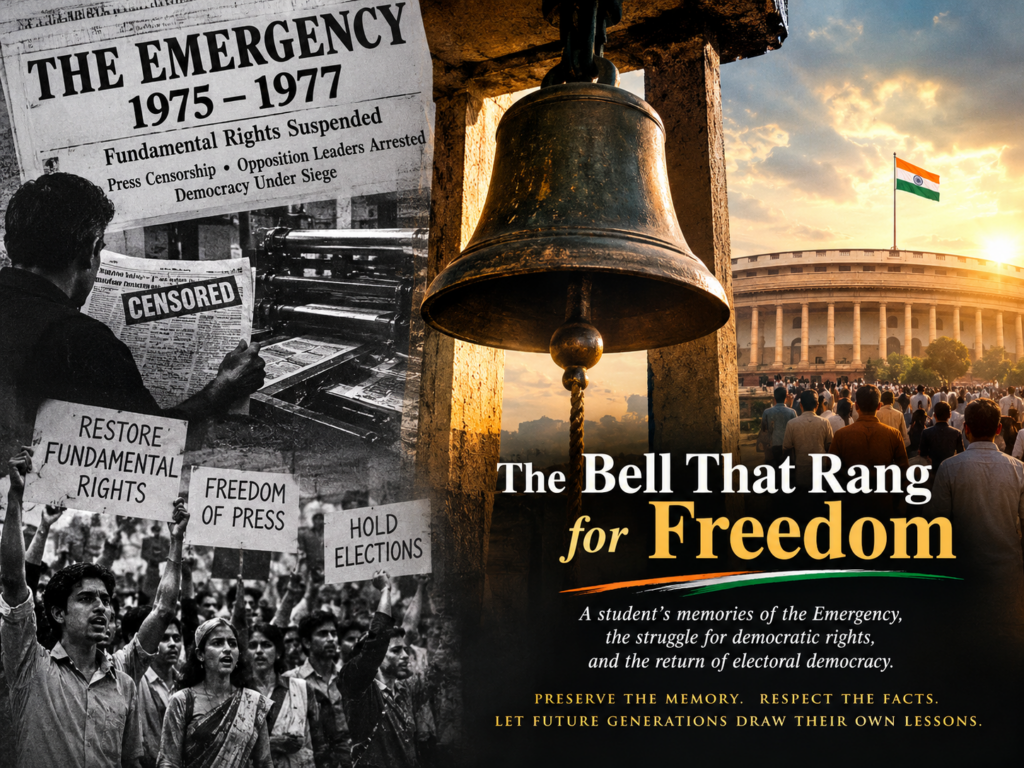
A Student’s Memories of the Emergency, the Struggle for Democratic Rights, and the Return of Electoral Democracy
Some memories belong not only to the people who lived through them, but also to the generations who must learn from them.
When History Became Personal
I was born in independent India. I had not lived through British rule, nor had I personally witnessed the historic moment of freedom in August 1947. Independence was a legacy I had inherited, something my generation knew through history, the stories of our elders, and the institutions of a free nation.
Then came the Emergency of 1975–1977.
For me, this was not merely a chapter in a history textbook. I was a college-going student, approaching the final year of my studies and preparing for my annual examinations. I was experiencing events that would leave a lasting impression on my understanding of freedom, democracy and the responsibilities of citizenship.
The restrictions imposed during the Emergency made me feel that the atmosphere of independent India was beginning to resemble the British rule I had read about in our history books. The two periods were not historically identical, but the comparison reflected how deeply the curtailment of democratic freedoms affected me.
I had been born into a free country. Why, then, should its citizens have to struggle to exercise the very freedoms that independence was meant to secure?
Three Demands That Belonged Together
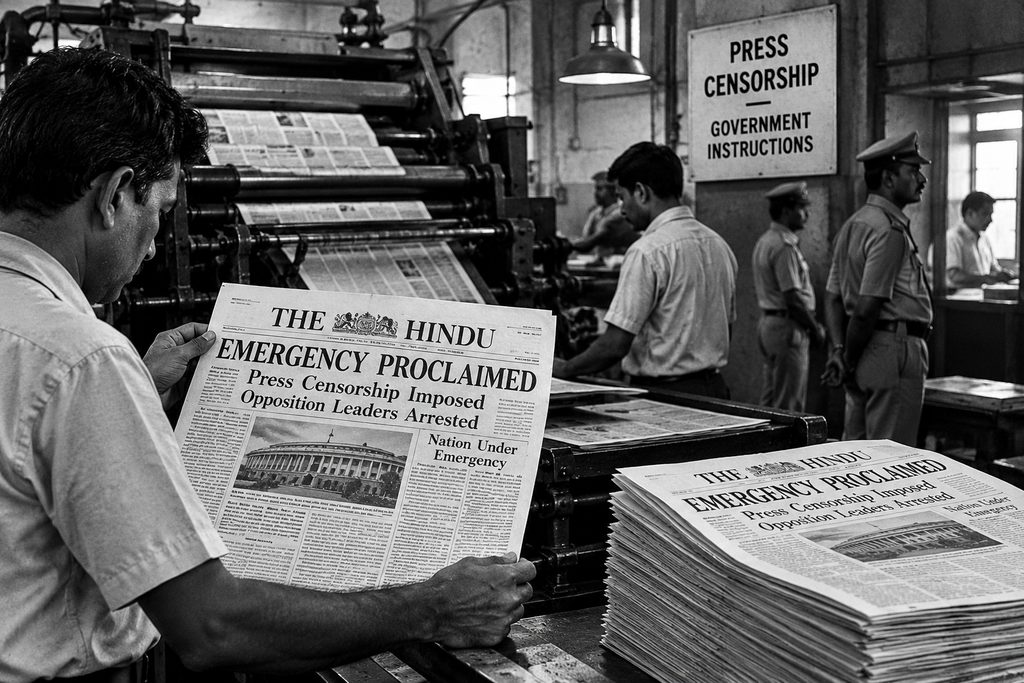
The Emergency was proclaimed on 25 June 1975. It followed a period of political unrest and a major judicial setback for Prime Minister Indira Gandhi. On 12 June 1975, the Allahabad High Court ruled against her in an election case. The Supreme Court subsequently granted a conditional stay, allowing her to remain Prime Minister while restricting her ability to vote in Parliament during the appeal.
The Emergency brought sweeping restrictions on civil liberties. Opposition leaders were arrested, and newspapers faced censorship. The ability of citizens to express dissent and seek legal remedies was severely curtailed.
For those of us concerned about the future of democracy, three demands stood together:
- Restoration of fundamental rights
- Freedom of the press
- The holding of elections
These were not isolated demands. They were interconnected pillars of a democratic society.
Citizens must be able to exercise their rights. Journalists must be able to report and question without undue interference. And the people must have the opportunity to choose their representatives through elections.
Without these safeguards, how can ordinary citizens effectively hold those in power accountable?
The People Behind the Protests
I remember the protests as expressions of public concern involving people from different walks of life. Students, senior citizens, housewives and ordinary citizens were among those who, as I recall, came forward to raise their voices for democratic rights.
What stays with me is the human dimension of those events. Political developments are often recorded through the names of leaders, the decisions of governments and the results of elections. Yet the consequences are also borne by people whose names never enter the history books.
Among the stories that have remained with me is that of two exceptionally meritorious students who rang their college bell in protest.
Their action, as I remember the account, led to their imprisonment. They subsequently lost two precious academic years and the opportunity they had hoped for of becoming MBBS doctors.
Think about what that meant. These were young people with the ability and ambition to pursue a demanding profession. Years of study, effort and preparation lay ahead of them. Yet their protest, and the consequences that followed, disrupted the course of their lives.
I have chosen not to identify the students, their college or the town. My purpose is not to expose individuals or institutions. It is to preserve the human cost of a period when the exercise of political dissent could carry serious personal consequences.
Their story reminds me that the price of standing up for a principle is not always measured in money. Sometimes, it is measured in years lost, opportunities missed and dreams that may never be fulfilled.
The Day the People Spoke
I cannot forget the general election of March 1977.
By then, I was in the final year of my college education. I had participated in peaceful protests because I believed that fundamental rights, freedom of the press and the right to elect a government were worth defending.
When the election results brought the Congress government out of power and the Janata Party formed a government, I experienced an overwhelming sense of relief.
I had not witnessed India’s independence in 1947. But the change of government in 1977 gave me a feeling that, in my own life, came close to understanding the emotional meaning of freedom.
It felt as though, after a long period of suffocation, a window had finally opened and fresh air had begun to flow in.
That is how I remember the moment: the freedom to breathe fresh air again.
The election demonstrated something essential about a democracy. However difficult the preceding period had been, the people were able to express their verdict through the ballot box and bring about a change of government.
For me, this was not simply a political outcome. It was a deeply personal moment of relief, and a lasting reminder that the power of citizens must never be taken lightly.
What Should the Younger Generation Remember?
Young Indians today have opportunities that earlier generations could only imagine. They can access information within seconds, communicate across continents, question established ideas and participate in public debate through digital platforms.
But access to information is not the same as understanding it. Nor should the freedom to speak be confused with freedom from responsibility.
The history of the Emergency offers lessons worth considering.
First, democratic rights must never be taken for granted. The rights we inherit may appear secure until circumstances reveal how much they matter.
Second, freedom of the press matters to every citizen. A society needs the ability to examine decisions, investigate wrongdoing, question authority and hear differing perspectives. An informed public is better equipped to make informed choices.
Third, elections are essential to democratic accountability. The opportunity to choose representatives peacefully gives citizens a means of expressing their collective will.
Fourth, dissent and responsibility must go together. A democracy needs space for peaceful disagreement. At the same time, historical events should be examined carefully, claims should be tested against evidence, and individual memories should be respected without confusing them with independently verified facts.
Finally, we must remember the ordinary people behind extraordinary events. Not everyone who contributes to the defence of democratic values becomes famous. Some pay a personal price that is known only to their families and communities.
The two students whose story I remember are part of that human dimension. Their names need not appear here for their experience to remind us that the consequences of political events can extend far beyond the immediate moment.
A Memory Preserved, a Lesson Left Open
I write this account as someone who lived through those days as a young college student. I do not claim that my memories encompass every event across the country, nor do I ask readers to accept every recollection without reflection. The broader historical record must be consulted, and facts must be distinguished from personal interpretation.
But memories also have a place in history. They help us understand how public events were experienced by ordinary people—how they affected their hopes, their education, their sense of security and their understanding of citizenship.
The Emergency ended in March 1977. The Congress government lost the general election, and the Janata Party formed the first non-Congress government at the Centre.
For me, the significance of that moment has never faded. It remains connected to the feeling I experienced when the people exercised their electoral power and a new government took office.
I had not witnessed the dawn of independence. Yet, in 1977, I felt the relief of a citizen who could breathe more freely again.
Perhaps that is why the memory of those days has stayed with me for so long.
History is not preserved only through official documents, court judgments, newspaper archives and political biographies. It is also preserved through the recollections of people who lived through its consequences.
The bell rung by two young students, the sacrifices I remember, the demands for democratic rights, and the relief that followed the election are all part of the story I wish to preserve.
I leave the younger generation with no demand to adopt my interpretation unquestioningly. Instead, I invite them to study the history, examine the evidence, listen to the experiences of those who were there, and draw their own considered conclusions.
Preserve the Memory. Respect the Facts. Let Future Generations Draw Their Own Lessons.
— A personal recollection for NaMo Akhand Bharat News
Stories That Inform. Ideas That Inspire. Bharat, also called as India, at the Heart.
Satyam Shivam Sundaram
सत्यं शिवं सुन्दरम्
सत्यं वद । धर्मं चर । राष्ट्राय समर्पित भव ।
Truth. Righteousness. Dedication to the Nation.