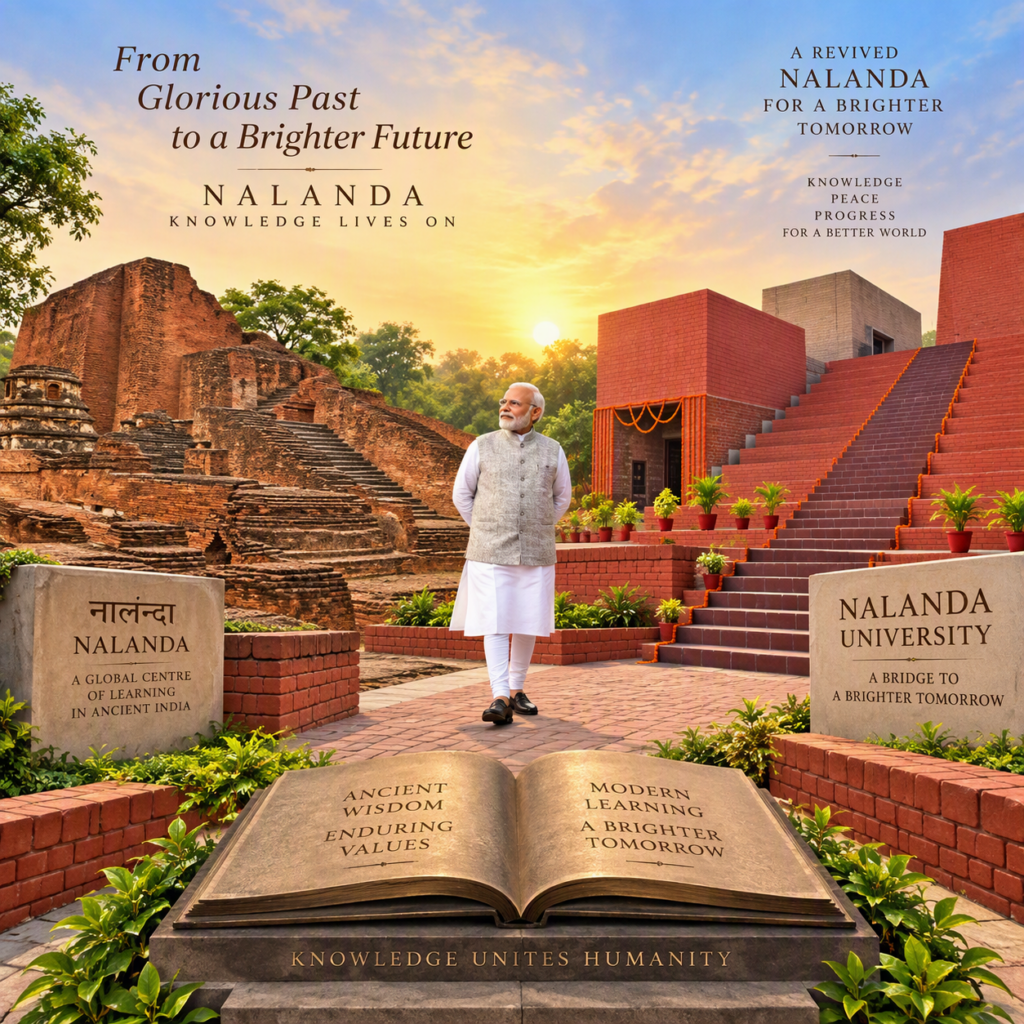
There are places where history is remembered. And then there are places where history comes alive again. Nalanda is one such place.
More than a thousand years ago, in the ancient land of Magadha in present-day Bihar, Nalanda emerged as one of the world’s greatest centres of learning. Flourishing from around the fifth to the twelfth century CE, it attracted scholars and students from across India and Asia to study, debate, research and exchange ideas. Nalanda became a powerful symbol of India’s ancient intellectual and cultural influence.
Centuries passed. The great university declined and eventually fell silent, but the spirit of Nalanda endured.
Today, Nalanda is being reborn.
नालंदा का पुनर्जागरण — जहाँ कभी ज्ञान की ज्योति जली थी, वहाँ फिर प्रकाश फैल रहा है।
The present-day Nalanda University was established in 2010 as a revival inspired by the legacy of the ancient institution. Its academic programmes began in 2014, and its new campus at Rajgir was inaugurated in June 2024.
Spread across a 455-acre eco-friendly campus, the modern university has emerged as an international institution, welcoming students and scholars from India and many other countries. Its academic programmes span areas such as Buddhist Studies, Philosophy, History, Ecology, Sustainable Development, Languages and Literature, alongside contemporary fields including Data Science and Artificial Intelligence, International Relations and Hindu Studies.
In doing so, the new Nalanda is not merely recreating the past. It is carrying its spirit into the future.
Knowledge Without Borders
Nalanda’s international character is perhaps its most powerful connection with its ancient heritage.
The modern university’s international vision is supported by cooperation involving the 17 East Asia Summit countries, fostering academic exchanges, scholarships and collaborative research.
Students and scholars from different nations once again gather at Nalanda—not as strangers, but as members of a global intellectual community. Their presence reflects the enduring power of learning to connect people across cultures and generations.
Its message is timeless:
Knowledge belongs to humanity. It transcends borders, languages and nationalities.
Ancient Wisdom, Modern Vision
The new campus reflects the possibilities of a modern India that values both innovation and sustainability.
Designed with environmental responsibility at its heart, the campus incorporates features such as solar power, water treatment and recycling, rainwater harvesting, and extensive natural water bodies.
Its facilities include modern classrooms, auditoriums, residential accommodation and spaces for academic and cultural exchange. The 2,000-seat Visvamitralaya auditorium, inaugurated during President Droupadi Murmu’s visit in March 2026, adds another landmark to the growing institution.
The revival of Nalanda therefore represents a remarkable meeting of ancient wisdom and modern innovation—a reminder that progress becomes more meaningful when it draws inspiration from enduring values.
A New Chapter in 2026
In March 2026, President Droupadi Murmu visited the Rajgir campus and attended the convocation ceremony, where degrees were awarded to 606 Master’s students and 10 PhD scholars. The graduates represented more than 30 countries.
The moment was deeply symbolic.
At a university that once attracted seekers of knowledge from across Asia, graduates from a new generation of nations were once again celebrating the achievements of learning.
The ancient Nalanda connected India with the intellectual world of its time. The new Nalanda seeks to do the same for our time.
A Message to the World
The revival of Nalanda reminds us that civilisation is not preserved merely by remembering its monuments. It is preserved by carrying forward the ideas, values and spirit that created them.
Nalanda’s greatest legacy was never only its buildings or libraries. It was its belief in learning, inquiry, dialogue, openness and the relentless pursuit of knowledge.
Those values remain as relevant today as they were centuries ago.
From the ancient land of Magadha to the modern campus of Rajgir, Nalanda stands as a bridge between India’s glorious past and humanity’s shared future.
The stones of ancient Nalanda may have fallen silent. But the idea behind them survived.
And today, that idea is speaking again.
Nalanda is not merely being rebuilt. It is being reborn.
A beacon of India’s ancient intellectual heritage has once again begun to shine—inviting the world to learn, discover, exchange ideas and build a better future together.
The Nalanda of yesterday inspired the world. The Nalanda of tomorrow can inspire the world once again.