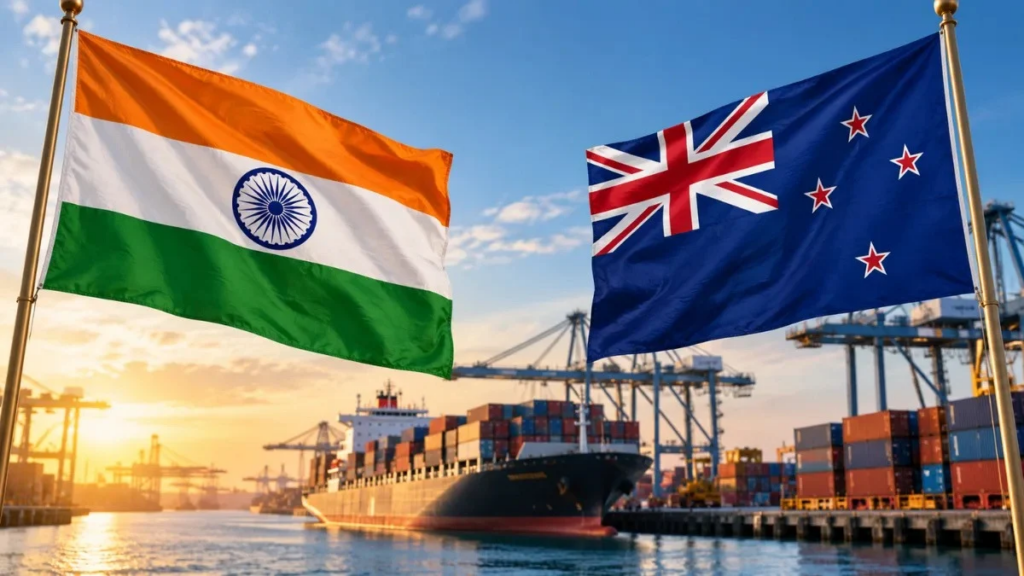
India and New Zealand aim to deepen trade ties, with tariff concessions for Indian exporters, a major investment commitment and a target of NZ$7 billion in bilateral trade by 2030. Sensitive sectors, including dairy, remain protected.
The India–New Zealand Free Trade Agreement (FTA) officially entered into force on 20 October 2026, offering 100% duty-free access for Indian exports to New Zealand and liberalising roughly 70% to 95% of India’s tariff lines for New Zealand goods.
Who Stands to Gain?
1. Indian Exporters & Farmers
- Full Duty-Free Access: New Zealand provides 100% duty-free access across all tariff lines and product categories from day one, removing previous tariff disadvantages (up to 10%).
- Key Sectors Benefiting: Fruits and vegetables, coffee, tea, cocoa, spices, cereals, processed foods, textiles and clothing, leather and footwear, pharmaceuticals, engineering goods, marine products, plastics, and rubber.
- Agricultural & Niche Gains: New Zealand has secured market pathways for Indian and Kiwi agricultural cooperation, including support for crops like kiwis, apples, and honey production.
2. Indian Services, Professionals & Students
- Expanded Service Sectors: Greater access across roughly 118 service sectors (including IT, audio-visual, construction, tourism, and professional services), with Most-Favoured Nation (MFN) treatment locked in across ~139 sub-sectors.
- Mobility & Visas:
- A dedicated quota of 5,000 Temporary Employment Entry visas annually for skilled Indian workers.
- 1,000 Working Holiday visas annually for young Indians aged 18 to 30 (allowing up to a 12-month stay).
- Post-Study Work Rights: Expanded starting 16 November 2026, granting Indian graduates with New Zealand PhDs up to 4 years of post-study work rights.
3. MSMEs, Startups & Women Entrepreneurs
- Zero-duty access and streamlined customs processes lower landed costs for micro, small, and medium enterprises (MSMEs), start-ups, artisans, and women-led businesses.
- Access to manufacturing/MSME supply chains is further boosted by zero-duty imports into India of critical inputs like wooden logs, coking coal, and metal waste/scrap.
4. Indian Consumers (What New Zealand Offers)
- Around 57% of New Zealand exports (rising to 82%–95% over full implementation) are tariff-free from day one, bringing competitive pricing on New Zealand goods such as:
- Sheep meat, wool, and forestry/wood products.
- Coal, wine, avocados, blueberries, and select horticultural items.
Industries Facing New Competition & Safeguards
- New Zealand Exports Entering India: New Zealand exporters gain preferential access on items like wool, sheep meat, forestry products, and select agricultural goods.
- Protected Sensitive Sectors in India:
- India has explicitly shielded sensitive domestic sectors—most notably dairy (core products like butter and cheese are excluded from liberalisation), along with sensitive agricultural segments.
- Certain agricultural imports from New Zealand remain subject to specific tariff-rate quotas and conditions rather than open-ended free access.
- Investment & Targets: New Zealand has committed to facilitating $20 billion in investments into India over 15 years to bolster manufacturing, infrastructure, and services, while both nations target doubling two-way trade.
Satyam Shivam Sundaram
सत्यं वद । धर्मं चर । राष्ट्राय समर्पित भव ।
Truth. Righteousness. Dedication to the Nation.
Pingback: India Economic Reforms 2026: Powerful Changes and Key Bills