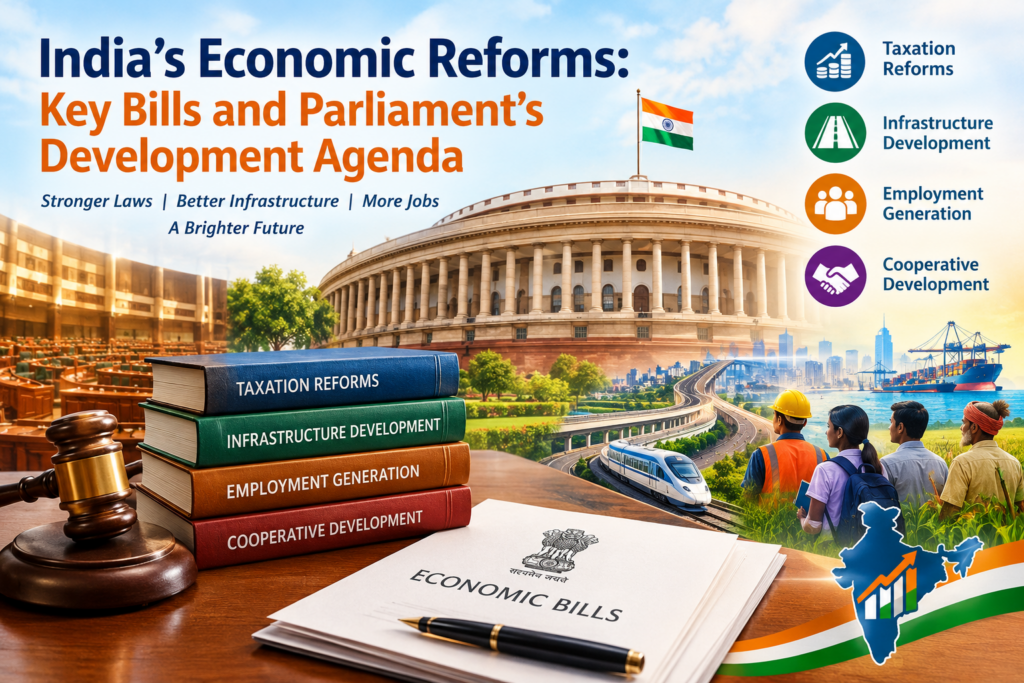
India economic reforms in 2026 are shaping important aspects of the country’s development journey, with legislation addressing taxation, mineral resources, cooperative development, and modern administration. India’s economic development depends not only on growth but also on effective laws, strong infrastructure, a predictable taxation system, and opportunities for employment. During the 2026 Monsoon Session, Parliament considered and passed several important bills with implications for economic reforms in India, taxation, fiscal reforms, industry, administration, and economic development. The session concluded on 13 August 2026, with 12 bills passed by both Houses of Parliament.
These legislative developments provide an opportunity to examine how parliamentary decisions can influence India’s economy, business environment, infrastructure, and long-term development priorities.
Economic Bills and India’s Development Agenda
Economic legislation can shape the environment in which businesses invest, industries expand, and citizens access opportunities. The bills considered during the Monsoon Session addressed a range of subjects, including taxation, mineral resources, banking records, and cooperative development.
However, the impact of legislation depends not only on its passage but also on the rules, administrative arrangements, and implementation measures that follow.
India Economic Reforms: Parliament and India’s development agenda
The Taxation and Other Laws (Amendment) Bill, 2026, was passed by Parliament during the Monsoon Session and received presidential assent on 17 August 2026 for economic liberalization in India and structural reforms.
The legislation amended provisions relating to income tax and other laws, including measures concerning certain foreign institutional investors and the Bank for International Settlements in relation to government securities. It also introduced changes affecting specified foreign companies involved in diamond trading and electronics manufacturing, subject to applicable conditions.
Tax policy can influence investment decisions, compliance costs, and business confidence. Clear rules and consistent administration are important for businesses planning long-term investments. The practical effects of individual tax provisions will depend on their implementation and the circumstances to which they apply.
Infrastructure and Mineral Resources
Infrastructure remains an important foundation for economic development. Roads, railways, ports, airports, and digital networks can improve connectivity, reduce logistics costs, and help businesses reach markets.
During the Monsoon Session, Parliament passed the Mines and Minerals (Development and Regulation) Amendment Bill, 2026. The legislation addressed aspects of the fiscal framework governing mineral rights and mineral-bearing land, with the stated objective of providing greater certainty and predictability in the mineral sector.
A stable regulatory environment can support planning and investment. At the same time, the broader benefits of infrastructure and resource development depend on effective implementation, responsible resource management, and attention to local economic needs.
Support for Rural and Cooperative Development
The National Co-operative Development Corporation (Amendment) Bill, 2026, was another measure passed during the session. It expanded the corporation’s scope to include activities involving industrial goods, including in rural areas, and broadened the categories of foodstuffs covered by its provisions.
Cooperative institutions can play a role in connecting producers, businesses, and markets. With suitable infrastructure, access to finance, and effective management, such institutions may help strengthen rural economic activity and create opportunities for local enterprises.
The actual benefits will depend on how effectively these provisions are implemented and how well the intended support reaches eligible communities.
Digital Records and Modern Administration
Parliament also passed the Bankers’ Books Evidence Bill, 2026, which addressed the admissibility of digital records of bankers’ books as evidence.
The recognition of digital records can support the modernisation of legal and administrative processes. More broadly, reliable digital systems can improve record management and efficiency, provided that appropriate safeguards, security measures, and procedures are in place.
Modern administration is an important part of building confidence in financial and public institutions.
Employment Generation: From Policy to Outcomes
Employment remains a major priority for a country with a large and diverse workforce. Taxation policy, infrastructure investment, industrial activity, and support for rural enterprises can all influence job creation, although their effects vary across sectors and regions.
Legislation alone cannot guarantee employment growth. Skills, access to credit, business conditions, infrastructure, and the ability of enterprises to expand are also important. Monitoring actual outcomes will therefore be essential when assessing the broader economic impact of reforms.
The Road Ahead
Parliamentary decisions form one part of India’s wider development journey. The economic legislation passed during the 2026 Monsoon Session addressed several areas relevant to taxation, mineral resources, cooperative development, and modern administration.
For citizens, businesses, and investors, the key questions concern implementation, transparency, accountability, and measurable results. The long-term value of economic reforms will ultimately depend on whether they support productive investment, strengthen institutions, expand opportunities, and contribute to inclusive development.
India’s economic reforms will ultimately be judged by their practical results: stronger investment, more employment opportunities, and improvements in people’s lives. Achieving these outcomes requires effective implementation, transparent assessment, and continued attention to the needs of citizens. The real measure of reform is not only the legislation passed, but also the lasting benefits it delivers.
India’s trade partnerships also contribute to its wider economic development. Read our article on the India–New Zealand trade agreement.
Sources and Further Reading:
Press Information Bureau — Monsoon Session of Parliament. 12 Bills Passed by Both Houses. Read the official press release.
Digital Sansad — Bills and Legislative Business. View Bills and Legislative Business.
Satyam Shivam Sundaram
सत्यं वद । धर्मं चर । राष्ट्राय समर्पित भव ।
Truth. Righteousness. Dedication to the Nation.
Pingback: India Among the World's Fastest Poverty Decliners: Has the Nation Come Closer to Winning Its War Against Extreme Poverty?