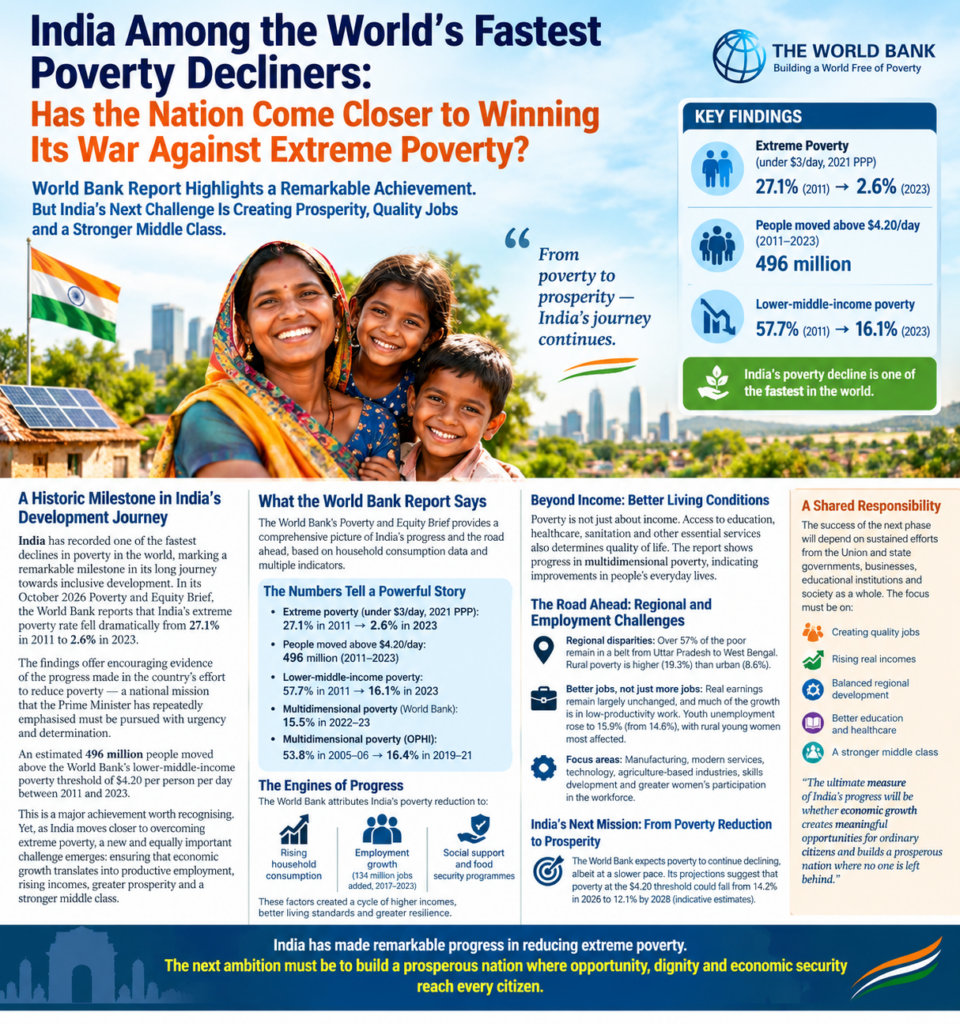
Fresh World Bank Report of October 2026 Highlights a Remarkable Achievement. India May Be Nearing the End of One Economic Struggle, But India’s Next Challenge Is Creating Prosperity, Quality Jobs and a Stronger Middle Class.
India Among the World’s Fastest Poverty Decliners, has recorded one of the fastest declines in poverty in the world, marking a remarkable milestone in its long journey towards inclusive development. In its October 2026 Poverty and Equity Brief, the World Bank reports that India’s extreme poverty rate fell dramatically from 27.1% in 2011 to 2.6% in 2023. The scale of India’s poverty decline is particularly significant given the country’s large population and the economic challenges it has faced.
The findings offer encouraging evidence of the progress made in the country’s effort to reduce poverty—a national mission that Prime Minister Narendra Modi has repeatedly emphasised must be pursued with urgency and determination. An estimated 496 million people moved above the World Bank’s lower-middle-income poverty threshold of $4.20 per person per day between 2011 and 2023.
This is a major achievement worth recognising. Yet, as India moves closer to overcoming extreme poverty, a new and equally important challenge emerges: ensuring that economic growth translates into productive employment, rising incomes, greater prosperity and a stronger middle class. The question is no longer only how to lift people out of poverty, but how to create lasting economic security and opportunity for them.
India Among the World’s Fastest Poverty Decliners, Records A Historic Decline in Extreme Poverty!
The World Bank measures extreme poverty using an international poverty line of $3 per person per day, expressed in 2021 Purchasing Power Parity (PPP) terms. On this measure, India’s extreme poverty rate declined from 27.1% in 2011–12 to 2.6% in 2023–24.
The report also examines poverty using the $4.20 per person per day threshold, the benchmark for lower-middle-income countries.
At this higher threshold, the share of India’s population living below the poverty line fell from 57.7% in 2011–12 to 16.1% in 2023–24. In absolute terms, an estimated 496 million people moved above this poverty threshold during the period.
These figures represent a substantial improvement in the economic circumstances of a large section of India’s population.
It is important to distinguish between the two measures: the 2.6% figure refers to extreme poverty at the $3 threshold, while the estimated 496 million people relate to the reduction in poverty at the $4.20 threshold.
The World Bank has described India’s progress as one of the fastest poverty declines in the world. This recognition places the country’s progress in an important international context.
What Helped India Reduce Poverty?
The World Bank identifies three important contributors to India’s poverty reduction: stronger household consumption, rising employment and expanded social transfers.
1. Rising household consumption
Growth in household consumption has helped improve people’s ability to meet their everyday needs. Better access to food, essential goods and services contributes directly to improvements in living standards.
2. Expansion of employment
Employment increased by approximately 134 million people between 2017 and 2023, nearly twice the growth in the working-age population.
A significant part of this increase came from rural women entering paid employment. More earning members in a household can improve its financial stability and ability to meet essential expenses.
3. Social support and food security
Expanded social transfers, including food subsidies, have also contributed to household welfare. Such support can protect vulnerable families from severe economic hardship and help them maintain consumption.
Together, these developments have contributed to the substantial decline in poverty recorded by the World Bank.
Progress Beyond Income: Improvements in Living Conditions
Poverty is not measured by income or consumption alone. Access to education, sanitation, healthcare and other essential services also determines the quality of life.
The report highlights progress in multidimensional poverty as well.
According to the Oxford Poverty and Human Development Initiative’s Multidimensional Poverty Index, India’s poverty rate declined from 53.8% in 2005–06 to 16.4% in 2019–21. The World Bank’s own multidimensional poverty measure stood at 15.5% in 2022–23.
These measures use different methodologies and reference periods, but both indicate substantial improvement in non-monetary aspects of poverty.
The progress demonstrates why development must be assessed not only through economic growth, but also through improvements in people’s everyday lives.
Regional Development: The Next Important Challenge
Despite the encouraging national figures, poverty reduction has not been uniform across India.
The World Bank reports that approximately 57% of India’s poor population remains concentrated in a contiguous belt extending from Uttar Pradesh to West Bengal. Sustaining India’s poverty decline will require faster development in regions where poverty remains concentrated, supported by investment, employment and effective public administration.
The rural–urban difference is also significant. In 2023–24, poverty at the $4.20 threshold stood at 19.3% in rural areas, compared with 8.6% in urban areas.
These findings underline the importance of balanced regional development.
State governments have an important responsibility in this regard. Industrial investment, infrastructure, education, healthcare, effective administration and the implementation of development programmes can influence the economic opportunities available to people.
The performance of governments in states where poverty remains concentrated deserves careful examination. Political leadership and administrative accountability must be assessed against measurable outcomes, rather than political claims alone.
A state’s development record must be examined in the context of its economic conditions, policies, investment climate, administrative capacity and the performance of successive governments. This is essential to understanding why some regions progress faster than others.
More Employment, But Better Employment Is Essential
The increase in employment is encouraging, particularly the growing participation of rural women.
However, the World Bank also points to an important concern: real earnings remained broadly unchanged, while much of the employment growth was concentrated in relatively low-productivity activities.
Youth unemployment also increased from 14.6% in the first quarter of FY2025–26 to 15.9% in the corresponding quarter of FY2026–27, with rural young women particularly affected.
This highlights the next major economic task.
India needs not only more employment, but also productive, stable and better-paying jobs. Greater opportunities in manufacturing, modern services, technology, agriculture-based industries and small businesses can help translate economic growth into higher household incomes.
Skill development, quality education and greater participation of women in the workforce will be important to this effort.
India’s Next Mission: From Poverty Reduction to Prosperity
The World Bank expects poverty to continue declining, although at a slower pace. Its projections indicate that poverty at the $4.20 threshold could fall from an estimated 14.2% in 2026 to 12.1% by 2028.
These are indicative estimates based on microsimulations and may change as new labour-market and macroeconomic data become available.
India’s achievement in reducing extreme poverty deserves recognition. It reflects a substantial improvement over the period examined by the World Bank and offers encouragement for the country’s continuing development journey.
At the same time, the next stage requires sustained attention to productive employment, rising real incomes, regional disparities and the quality of public services.
The responsibility rests with governments at both the Union and state levels, businesses, educational institutions and society as a whole. Public policies must create an environment in which investment can grow, enterprises can generate employment and citizens can access better opportunities.
Has India Won Its War Against Extreme Poverty?
The World Bank’s findings provide strong grounds for optimism. India has made remarkable progress, and its poverty reduction is recognised internationally as one of the fastest in the world.
But the journey is not over. Millions of people continue to face economic vulnerability, while the quality of employment, rural development and regional disparities remain important concerns.
The ultimate measure of India’s progress will be whether economic growth creates meaningful opportunities for ordinary citizens, enables families to build financial security and allows every region to participate in the country’s development.
India’s next stage of development will also depend on sustained economic reforms and effective policy implementation, issues explored in our article on India’s Economic Reforms: Key Bills and Parliament’s Development Agenda
India has made remarkable progress in reducing extreme poverty. The next ambition must be to build a prosperous nation where opportunity, dignity and economic security reach every citizen.
Sources and Further Reading
- World Bank – Poverty and Equity Briefs, October 2026:
https://www.worldbank.org/en/topic/poverty/publication/poverty-and-equity-briefs - World Bank – India Development Update, April 2026:
https://thedocs.worldbank.org/en/doc/4262e1e15b463ecb360cec4ad78cf062-0310012026/india-development-update-april-2026 - World Bank – India Development Update, October 2026:
https://www.worldbank.org/en/news/press-release/2026/10/06/india-development-update-oct-2026
Satyam Shivam Sundaram
सत्यं वद । धर्मं चर । राष्ट्राय समर्पित भव ।
Truth. Righteousness. Dedication to the Nation.