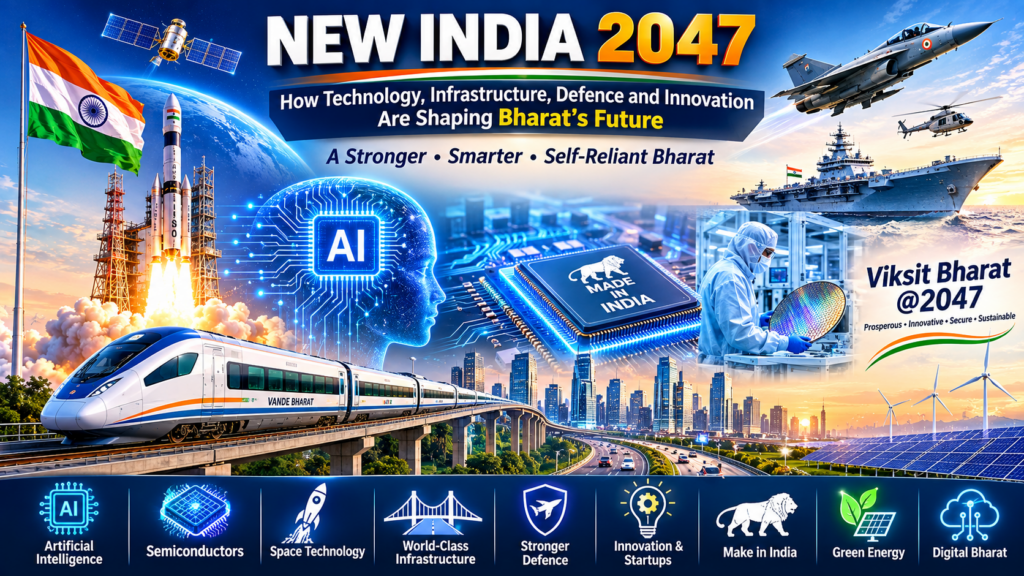
India is entering a defining period in its long civilisational journey. As the nation moves towards 2047—the centenary of its independence—the vision of a developed, self-reliant and globally influential Bharat is becoming increasingly connected with technology, infrastructure, defence capabilities and innovation.
The India of 2047 will not simply be a larger version of today’s India. It has the potential to be a fundamentally transformed nation—digitally connected, technologically advanced, economically stronger and capable of making a greater contribution to the world.
The foundations for that transformation are already being built.
From Ancient Knowledge to Modern Innovation
India has a long tradition of knowledge and innovation.
Ancient Indian scholars made important contributions to mathematics, astronomy, medicine, metallurgy and philosophy. Today, that spirit of innovation is finding expression in artificial intelligence, space technology, biotechnology, digital platforms, advanced manufacturing and other emerging fields.
The transformation is significant because modern India is combining its large pool of scientific and technical talent with a rapidly expanding digital economy.
Young entrepreneurs, engineers, researchers and innovators are creating solutions for both Indian and global markets.
The objective is increasingly clear: India should not merely consume technology created elsewhere. It should also develop, manufacture and export technologies of its own.
The Digital Bharat Revolution
Technology is already changing everyday life across India.
Smartphones, high-speed internet, digital payments, online education, telemedicine, digital banking and government services have brought millions of people into the digital economy.
India’s digital public infrastructure has become one of the most important foundations of this transformation.
Digital identity, payments and online service platforms are creating new possibilities for citizens, businesses and government institutions.
Looking towards 2047, technologies such as artificial intelligence, quantum computing, robotics, advanced telecommunications and cybersecurity are likely to become increasingly important.
The challenge will be to ensure that technological progress remains inclusive and benefits people across cities, towns and villages.
Infrastructure: Building the Physical Foundation
A technologically advanced nation also requires strong physical infrastructure.
India is witnessing major development in highways, expressways, railways, airports, ports, metro systems, logistics networks and urban infrastructure.
Modern transport networks can reduce travel time, improve trade and strengthen connections between manufacturing centres, agricultural regions, ports and markets.
High-speed and modern railway networks can transform passenger and freight movement.
Improved ports and logistics infrastructure can strengthen India’s position in global supply chains.
The development of infrastructure is therefore not merely about constructing roads and buildings. It is about creating the physical foundation for economic growth.
Smart Cities and Connected Communities
The cities of the future will increasingly depend on technology.
Smart traffic management, intelligent public transport, digital governance, efficient waste management, renewable energy and modern water systems can improve urban living.
At the same time, India’s development cannot be limited to major metropolitan cities.
Digital connectivity and improved infrastructure can give smaller towns and rural communities access to education, healthcare, financial services and new economic opportunities.
The Bharat of 2047 will need both world-class cities and prosperous villages.
A Stronger and More Self-Reliant Defence Sector
National development and national security are closely connected.
India is increasingly focusing on strengthening domestic defence manufacturing and developing advanced military technologies.
Indigenous missiles, aircraft, naval systems, drones, radar technologies, electronic warfare systems and space-based capabilities represent important areas of strategic development.
The emphasis on self-reliance in defence can reduce dependence on foreign suppliers while creating opportunities for Indian industries, startups and research institutions.
Future warfare will increasingly involve artificial intelligence, autonomous systems, cyber operations, satellites, precision technologies and advanced surveillance.
India’s ability to develop these capabilities will be an important part of its strategic preparedness.
Space: The New Frontier
India’s space programme has become a symbol of technological ambition.
From satellite communications and navigation to lunar and solar missions, Indian scientists and engineers have demonstrated the ability to undertake sophisticated space programmes.
The future could see India playing a much larger role in commercial space activities, satellite technology, space research and potentially human spaceflight.
Space technology will also have practical applications on Earth, including agriculture, weather forecasting, disaster management, communications and national security.
The sky is no longer simply a frontier to observe. It is becoming an increasingly important part of India’s technological future.
Artificial Intelligence and the Innovation Economy
Artificial intelligence is likely to become one of the most transformative technologies of the coming decades.
India has a significant advantage in its large technology workforce, expanding startup ecosystem and enormous domestic market.
AI can potentially improve healthcare, education, agriculture, transportation, manufacturing and public administration.
However, responsible development will be essential.
India will need skilled professionals, strong cybersecurity, ethical standards, reliable digital infrastructure and policies that encourage innovation while protecting citizens.
The opportunity is enormous: India could become not only a major user of AI but also a significant developer of AI technologies and applications.
Manufacturing and Make in India
A developed India will require a strong manufacturing base.
The growth of electronics, automobiles, pharmaceuticals, renewable energy equipment, semiconductors, defence products and other advanced industries can create employment and strengthen India’s position in global supply chains.
The goal is to move increasingly towards producing high-value products within India.
A stronger manufacturing ecosystem can also encourage research, innovation, skill development and entrepreneurship.
The combination of manufacturing and technology could become one of the strongest engines of India’s economic transformation.
Green Growth and Sustainable Development
India’s future cannot be built without considering environmental sustainability.
Renewable energy, electric mobility, green hydrogen, energy-efficient buildings, modern public transport and sustainable industrial practices are likely to become increasingly important.
India has enormous potential in solar and other renewable energy sources.
The transition towards cleaner energy can simultaneously strengthen energy security, reduce environmental pressures and create new industries.
The India of 2047 will need to demonstrate that economic development and environmental responsibility can progress together.
The Power of India’s Youth
Perhaps India’s greatest advantage is its people.
Millions of young Indians are entering the workforce every year. Their skills, creativity and ambitions can become a major source of national strength.
Education and skill development will therefore be critical.
India will need scientists, engineers, entrepreneurs, doctors, teachers, skilled technicians, defence specialists, researchers and creative professionals.
A developed nation is ultimately built by capable people, not only by machines and infrastructure.
Bharat in 2047
What might India look like when it reaches 100 years of independence?
It could be a nation with advanced digital infrastructure, modern transportation, globally competitive industries, stronger defence capabilities, world-class research institutions and a thriving innovation ecosystem.
It could also be a nation where technology reaches villages as effectively as cities, where young people have greater opportunities and where India’s ancient cultural heritage continues to coexist with cutting-edge modernity.
The journey will not be easy.
India will face challenges involving employment, education, urbanisation, environmental sustainability, cybersecurity, inequality and global competition.
But the scale of the opportunity is equally extraordinary.
Building the Future Today
New India 2047 is not a destination that will suddenly appear in the year 2047.
It is being created every day through decisions made today.
Every new highway, research laboratory, startup, satellite, digital service, defence system, manufacturing facility and educational institution contributes to the larger transformation.
The future of Bharat will depend on combining the wisdom of its civilisational heritage with the possibilities of modern science and technology.
From ancient knowledge to artificial intelligence, from historic trade routes to modern expressways, from traditional craftsmanship to advanced manufacturing, India’s journey continues to evolve.
As Bharat moves towards 2047, the central question is not simply how advanced the country can become.
It is how wisely it can use its capabilities to create a prosperous, secure, innovative and confident nation.
New India 2047 is therefore more than a vision of the future.
It is a national journey already underway—and the generations of today have the opportunity to shape the Bharat of tomorrow.